
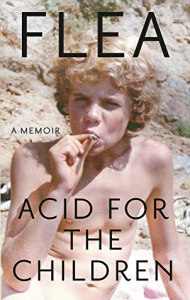
Since 1983, the Red Hot Chili Peppers have been rocking the world with their funk-rock sound. While most of their peers have faded out of the limelight, passed away, or retired, the Chilis continue to perform sold-out stadium shows in front of thousands of fans, many of whom are much younger than the band they’re rocking out to. Red Hot Chili Peppers has featured several different band members over the decades, but two have remained since the very beginning; vocalist Anthony Kiedis and bassist Michael Balzary, better known as Flea for his habit of jumping up and down wildly on stage. Fans of the rock band may be aware that Keidis published his memoir, Scar Tissue, in 2003, but now it’s Flea’s turn and it seems playing bass isn’t the only thing our author excels at.
I wouldn’t blame anyone for approaching Flea’s memoir, Acid for the Children, with a little hesitance. After all, there are countless rockstar memoirs out there and they can feel like an easy cash grab for an ageing musician looking to relive the glory days of their sex, drugs, and rock ‘n’ roll lifestyle while also helping to pay for a new private jet or infinity pool. I was relieved to find that Flea’s biography does not fall into this category. When the project was first announced, our author made it clear this was not another tell-all celebrity memoir, instead he approached it as a serious piece of literature, something he hoped would still appeal to someone who had never even heard of him or his band. “It’s my great hope that it could be a book that could live beyond being a celebrity book or a rockstar book and just stand on its own as a piece of literature,” he said. Sure, we’ve heard this sort of thing before from celebrity authors, but I’m very pleased to report that Flea achieved exactly what he hoped for.
The first thing you should know about the memoir is that it is not about his career with his band. Flea’s writing focuses on his childhood and adolescences and ends with him playing his first gig with the members that would eventually go on to found the Chili Peppers. Flea’s book isn’t about giving fans an inside look at the long journey he’s been on as a musician, it’s about examining his chaotic childhood and figuring out how it lead him to become the man he is today. Acid for the Children begins before Flea was even born, introducing readers to his grandparents, before focusing on a young boy born in Melbourne, Australia who, at the age of four, moved with his family to the other side of the world to New York City. From there Flea recounts his wild upbringing that will make you laugh out loud at his boyhood antics, as well as hold back tears as you want to reach through the pages and tell the lost child all will be well.
When I say I read Acid for the Children, I actually listened to it. While I generally prefer to consume books the old fashioned way, I do like to listen to audiobooks on my commute to work, and I’m personally of the opinion that audiobooks have the potential to be just as good as physical ones, sometimes even better. This is certainly the case for Flea’s memoir and I urge you to give the audiobook version a go if you have the chance. Hell, even if you’ve already read the book, give it a second go-around with Flea narrating the action for you, you’ll not regret it. It begins with an introduction read by Patti Smith and Flea then takes over to narrate his life with enthusiasm, sometimes using music to underscore his words. It was a joy hearing Flea chuckle as he narrated funny moments in his childhood, and heartbreaking to hear him choking on his words as he relived some of his darkest moments. I truly believe the audiobook edition is the best edition.

To put it mildly, Flea was a wild child experiencing a wild upbringing and, if I’m being brutally honest, I believe some of the things he endured would be called abuse by today’s standards. After his mother and father broke up, Flea’s father returned to Australia and left our author and his sister with their mother and her tragically unstable boyfriend Walter. As a jazz musician, Walter is largely responsible for igniting Flea’s passion for music, though he was also the cause of much distress, anxiety, and mental anguish. Later in his childhood, Flea spent time living with his father back in Australia, but as a no-nonsense, tough, and upright father, the two often clashed and before long Flea returned to the US. While there were certainly moments of beauty, laughter, and fun in his childhood, there were also numerous moments of violent rage and, by the age of 13, Flea was regularly smoking cannabis to cope.
It’s Flea’s story to tell, so I’ll say no more, but there are moments when our young bassist feels more like a tragic character from a Dickens novel than the funky rocker we know today. Reading Flea’s account of his childhood, I am struck by the almost zen-like acceptance and forgiveness he has for those who showed such a lack of attention to his wellbeing. I could hardly blame our author were he to express hatred and bitterness for his past and those in it, but it a testament to his character that he shows love and forgiveness to those who raised him. Flea said he hoped his book would stand on its own merit, and I believe the main reason it will is because of the way he can examine fear, anger, loneliness, and depression, things many of us can relate to, especially those who didn’t enjoy a stable family unit as a child. You may be getting the impression that the entire book is a long slog of misery, but it’s not. There are plenty of moments of mirth, and it’s clear he doesn’t regard his childhood as one miserable episode.
I was surprised to learn that both Flea and his sister are huge book worms and it’s clear that decades of reading have rubbed off on him. Flea proves himself to be every bit as skilled with language as with his trumpet or bass and I found his style to be just as engaging as many of the greats. He’s fun, insightful, and unpretentious and in his narration, he uses his voice to great effect to mimic moments of garbled gibberish, drunken slurring, and unrestrained excitement. Frankly, I would read a shopping list written by Flea.

On a more personal note, I have been a Chili Pepper’s fan for many years, and I have many memories associated with them. As fond as I am of them, I do have to admit that I much prefer the band after they’d kicked their demons and were off the drugs to their wild days in the ’90s. To be honest, as young men they seemed like the kind of guys I avoid and would hate to be like. I’d always found it hard to understand how they’d gone from arrogant, cliched rockstars, to the far more mellow, middle-aged, men they’ve been in recent years, but reading Flea’s memoir has helped me understand. Having read some of the things Flea and Anthony got up to as kids, I’m convinced they’ve both got guardian angels watching over them, else they’d either be in prison or dead. In the book’s closing, Flea acknowledges the damage his wild lifestyle has caused both himself and those around him and feels he benefitted nothing from his drug-fuelled years. Now in his 50s, Flea thrives on the highs he gets from exercising, exploring nature, and his passion for life, which he states far outweigh the highs brought on by pumping chemicals into his veins. Many readers, especially younger ones, will no doubt find Acid for the Children a comforting read despite its sometimes dark moments. It serves to show that even those going through the darkest times can one day thrive, and I’m so glad or author survived his younger years to pass on his wisdom.
If you’re a fan of Flea then you should absolutely pick this one up, but it’s also a must for anyone looking for a tender examination of childhood and teenage years. Flea ends the book by jokingly urging the reader to stick around for part 2, he may have his tongue firmly in his cheek, but I hope this is not the last we’ve seen of Flea’s literary career.
Read More:
- Gates of Fire – Steven Pressfield
- Norwegian Wood – Haruki Murakami
- Lincoln in the Bardo – George Saunders
- The Silmarillion – J.R.R. Tolkien

More from my site
 Musui’s Story: Autobiography of a Tokugawa Samurai – Katsu Kokichi
 Alexander Hamilton – Ron Chernow
 One Day in the Life of Ivan Denisovich – Aleksandr Solzhenitsyn
 The World of Ice and Fire – George R.R. Martin, Elio M. Garcia Jr, Linda Antonsson
 Farewell, Sir Terry Pratchett
 The Wisdom of Psychopaths – Kevin Dutton